✓ Royal Mail Authorised Inspector since 2008 | Trading since 2005


Not all envelopes are the same – the right one depends on your paper size, the weight of the contents, the seal you need and the style. This guide covers the common envelope sizes, paper weights, seal types and styles so you can pick the correct envelope for your post. Most can be supplied by Mailcoms – view our range of envelopes here.
Envelope sizes
DL – 110 x 220mm
One of the most common envelopes. A DL takes standard 1st or 2nd class postage and is perfect for a single sheet, or multiple sheets, of A4 folded twice.
C6 – 114 x 162mm
Designed for A4 folded into quarters, or for A6 paper and card, or A5 folded in half.
C5 – 162 x 229mm
The largest envelope that takes standard 1st or 2nd class postage – check the weight with contents (easy with a franking machine). Use for A4 folded once in half, or an unfolded sheet of A5.
C4 – 324 x 229mm
A large letter envelope, ideal for an unfolded A4 sheet and important business documents. Check weight and format, as postage depends on the contents.
Envelope weight
Envelope weight refers to the thickness of the paper, measured in grams per square metre (gsm).
80gsm
Lightweight and reliable – perfect for invoices, receipts and everyday mail of up to three A4 sheets.
90gsm
Slightly stronger with more opacity – ideal for more secure or sensitive contents, up to around fifteen sheets.
100 – 110gsm
Thicker – ideal for letterhead correspondence and a great first impression.
120 – 130gsm
Some of the strongest available – for bulkier contents and brochures.
Envelope seal
Gummed envelopes
The traditional lick-and-stick flap – perfect for folding inserting machines, where the flap is moistened automatically.
Peel and seal envelopes
A peel-off strip seals the flap. Labour-intensive to do by hand, so less suited to large mailouts, but with a longer shelf life.
Self seal envelopes
Sealed by pressing the flap down – convenient, and often used as customer return envelopes.
Types and styles of envelope
Pocket envelopes
Open along the short side – used for most franked mail and general office use.
Wallet envelopes
Open along the long side – the most common style, used in folding inserting machines and mass mailing.
Banker envelopes
The greetings-card style with a triangular flap – used for cards and invitations.
Window envelopes
A window shows the address on the enclosed letter, saving you addressing the envelope.
Gusset envelopes
Expanding sides for larger documents, catalogues and bulky paperwork – most common in C4.
Padded and bubble lined envelopes
Also called jiffy bags – padded to protect contents, lightweight and frankable for lower-cost sending.
Security envelopes
Tamperproof and tear-resistant, often opaque to keep contents private.
Polythene envelopes
Strong plastic to protect contents from water – used for medical, financial and secure documents.
Why not frank your envelopes?
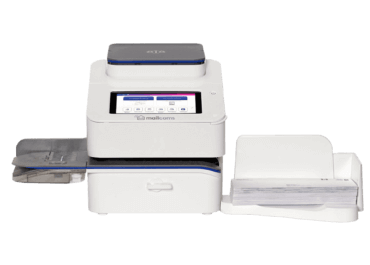
A franking machine brings down your postage costs, removes the risk of over- or under-paying, and is more convenient to use. Mailcoms is a Royal Mail Authorised Independent Inspector & Maintainer of franking machines, so we can provide a Mailmark franking machine to suit your needs. If you are interested in getting one or upgrading to Mailmark with lower prices available, please view our franking machine page here or call us today on 01543 572 776.
Frequently asked questions
What is a DL envelope used for?
A single sheet or multiple sheets of A4 folded twice; it takes standard 1st or 2nd class postage.
What is the largest envelope for standard 1st or 2nd class postage?
A C5 (162 x 229mm), though you should check the weight with the contents.
What does gsm mean on an envelope?
Grams per square metre – the thickness of the paper. Higher gsm is stronger and more opaque.